

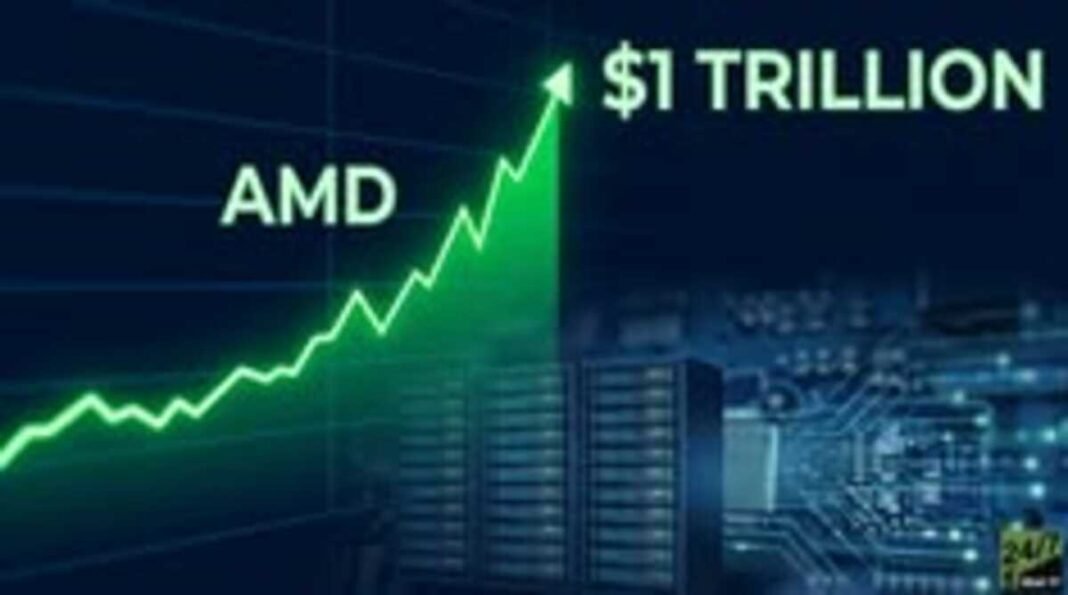
Micro Devices has entered a very select club, surpassing one trillion dollars in market capital for the first time. Shares soared nearly ten percent on Monday to a record high close of close to 615 dollars, catapulting the long-established chip maker into rarefied company previously occupied by just a handful of popular technology titans.
The milestone comes after a phenomenal run for AMD stocks, which have risen over 185 percent this year.. Since the AMD has been baking itself into the rapidly expanding artificial intelligence hardware space, an area once occupied almost entirely by Nvidia..AMD has become the most serious contender in the graphics processing unit business and has gone even further by providing entire server systems comprising not just processors and accelerators, but also networking hardware.
A modest change in the demand for computing power lies behind the figures. Data centers across the globe are shopping to buy the specialised chips they need to train and operate large AI models. In the latest quarter AMD posted data center sales of 6.7 billion dollars, more than two times the figure a year earlier. The company’s overall turnover was up 50 percent, to about 11.5 billion dollars, helped by rising profit margins as more expensive products made up an increasingly large proportion of sales. As chief executive Lisa Su data-center sales could double in the coming year if trends persist.
AMD has not contented itself with stealing share from Intel in the computer chips that are found in only the smallest and simplest computing tasks, but began breaking its dominance in the world of powerful server chips. AMD’s EPYC series of microprocessors have achieved a growing share of this business, providing AMD with an opportunity for powerful growth apart from its Instinct AI accelerators. This combination of success has convinced most investors that AMD is no longer a second-tier of computing provider, but a comprehensive provider of the infrastructure required by contemporary AI.
The bandwagon mentality is also visible in AMD’s valuation. AMD is now valued at as much as 41 times forward earnings, a huge premium to Nvidia’s current multiple and indicative of expectations of ongoing impressive growth. The uptrend in the semiconductor sector continued, with Intel and Qualcomm also climbing strongly on the same day, reflecting an upbeat outlook for the ongoing AI-fuelled investment cycle.
Crossing the trillion-dollar mark is more than a numerical milestone. Before AMD joining the club, only three other American chipmakers (Nvidia, Broadcom and Micron) had ever done so. Nvidia still dwarfs AMD with a market value of over five trillion dollars, but AMD’s debut signifies an equivalence between the two that previously appeared insurmountable. For a company that spend years to re-establish itself after falling on the verge of redundancy in the PC cpu market, it must feel like everything has changed.
But there are challenges too. Competition is fierce, customer concentration with the biggest cloud companies is high, and a reduction in AI capex would be likely to rapidly dampen investor excitement. But, the underlying factors, which got AMD to this stage – the demand from enterprises and cloud operators for AI capacity and the continued requirements for powerful GPUs and CPUs appear to be in robust health for the foreseeable future.
