

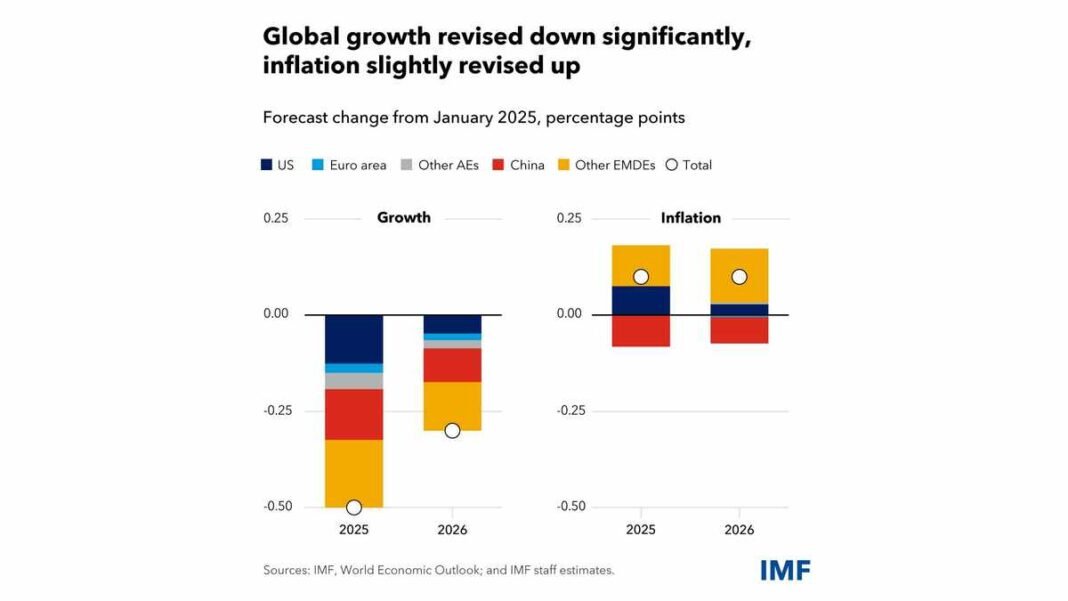
The global economy is entering a fragile phase in 2026, as the International Monetary Fund (IMF) has issued a stark warning about slowing growth driven by rising geopolitical tensions and energy market disruptions. In its latest World Economic Outlook, the IMF highlights how conflicts, particularly in the Middle East, are reshaping economic momentum and creating uncertainty across global markets.
According to the IMF’s April 2026 report, global economic growth is now projected to slow to around 3.1% in 2026, a noticeable drop compared to earlier expectations and well below pre-pandemic averages. This downgrade reflects the growing strain caused by geopolitical instability, rising energy prices, and tightening financial conditions that are collectively weakening global demand.
One of the biggest drivers behind this slowdown is the ongoing conflict in the Middle East, which has disrupted critical oil supply routes and pushed energy prices higher. The IMF warns that these disruptions are not just temporary shocks but could have lasting consequences on inflation and economic stability. Higher oil and gas prices are increasing production costs worldwide, forcing businesses to cut investments while consumers face rising living expenses.
The impact is being felt unevenly across regions. Emerging and developing economies are particularly vulnerable due to their dependence on energy imports and limited fiscal buffers. In many of these countries, inflation is rising faster, and currencies are under pressure, making recovery even more difficult. Advanced economies, while more resilient, are also experiencing slower growth as high interest rates and cautious consumer spending weigh on economic activity.
The situation becomes more concerning when considering alternative scenarios outlined by the IMF. If geopolitical tensions persist or escalate further, global growth could fall to as low as 2.5% or even approach recession levels under severe conditions. This highlights the fragile balance the global economy currently faces, where prolonged conflict could trigger a chain reaction affecting trade, investment, and financial markets.
Energy remains at the center of this crisis. Supply disruptions in key transit routes have already caused spikes in oil prices, with ripple effects across industries such as transportation, manufacturing, and aviation. These price shocks are also feeding into inflation, forcing central banks to maintain tighter monetary policies for longer periods. As a result, borrowing costs remain high, limiting both consumer spending and business expansion.
Beyond energy, geopolitical fragmentation is also affecting global trade patterns. Countries are increasingly focusing on regional alliances and domestic production, which, while improving resilience, may reduce the efficiency of global supply chains. The IMF warns that such fragmentation could slow long-term economic growth and reduce the benefits of globalization that have supported economies for decades.
Despite these challenges, the IMF notes that some underlying strengths still exist in the global economy. Labor markets in several advanced economies remain relatively stable, and technological advancements continue to drive productivity gains in certain sectors. However, these positives are not strong enough to fully offset the risks posed by geopolitical instability and rising inflation.
Looking ahead, the IMF emphasizes the need for coordinated global policy action. Governments are encouraged to focus on targeted fiscal support rather than broad subsidies, while central banks must carefully balance inflation control with growth support. Strengthening international cooperation will be crucial in navigating this uncertain economic environment.
In conclusion, the IMF’s latest outlook paints a cautious picture of the global economy in 2026. While a full-scale recession is not inevitable, the risks are clearly tilted to the downside. As geopolitical tensions continue to evolve, the world economy stands at a critical juncture where policy decisions and global cooperation will determine the path forward.
